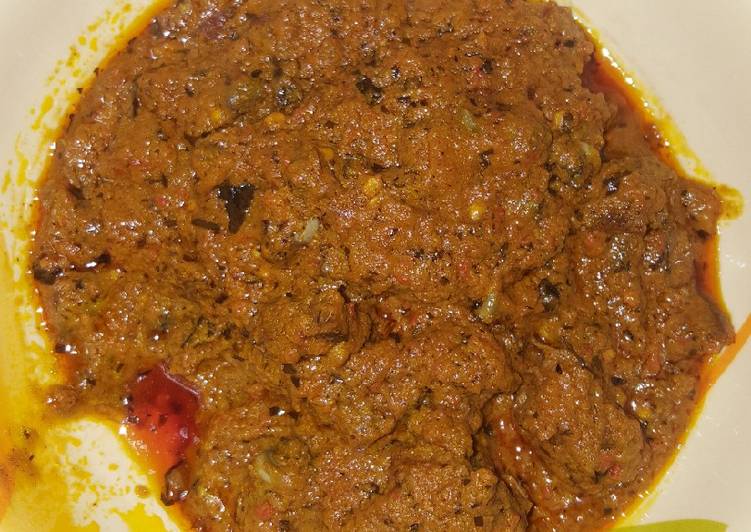
Hey everyone, it’s Brad, welcome to our recipe page. Today, we’re going to make a distinctive dish, isoko type of banga soup. It is one of my favorites. For mine, I’m gonna make it a bit unique. This will be really delicious.
Isoko type of Banga soup is one of the most favored of recent trending foods on earth. It’s enjoyed by millions daily. It’s easy, it’s quick, it tastes delicious. Isoko type of Banga soup is something which I have loved my whole life. They are fine and they look wonderful.
Banga soup spice(you can get it from food stuff sellers) Dry leaf(we call it benetete)i dont know the english name🙆♀️ Steps. I made this one very simple. First put your palm nut in a pot and put on fire to cook till tender. Banga, also known as Oghwo amiedi in Urhobo language and izuwo ibiedi in Isoko language, is a type of palm fruit soup from Southern the Niger Delta Nigeria particularly the Itsekiri ethnic group.
To begin with this recipe, we must prepare a few ingredients. You can have isoko type of banga soup using 10 ingredients and 9 steps. Here is how you can achieve it.
The ingredients needed to make Isoko type of Banga soup:
- Prepare Palm nuts (banga)
- Get Tomatoes blended
- Make ready Fresh pepper (blended)
- Take Meat of choice
- Prepare Periwinkle
- Prepare Crayfish (blended)
- Prepare Kpomo
- Prepare Seasoning of choice
- Make ready Banga soup spice(you can get it from food stuff sellers)
- Make ready Dry leaf(we call it benetete)i dont know the english name🙆♀️
Banga soup is healthy and is rich in potassium and vitamin E. The palm nut oil extract is rich in heart-friendly, low saturated fat and is cholesterol-free. It is known as Oghwoamiedi in Urhobo language and Izuwoibiedi in Isoko. Banga soup is basically palm fruit soup.
Steps to make Isoko type of Banga soup:
- I made this one very simple. First put your palm nut in a pot and put on fire to cook till tender.
- When your palm nut is tender, bring down from fire and pour into your mortar and start pounding. B4 then, put water on fire in a kettle and allow to boil.
- When the skin is out of the kernel, transfer it into a bowl and the start squeezing with your hand to extract the oil from the nut. Add hot water gradually to help you strain out all the oil. Your banga water is ready.
- Then seive the oil into a pot and place on fire. Now for this part, i like cooking my meat with my banga water, this helps the meat absorb the soup taste.
- Into the pot on fire, add tour washed meat and kpomo and allow to cook very well, till the oil and the water of the pakm nut is mixed together.
- Now add your blended tomatoes, pepper, onion, crayfish, then cover the pot and allow to cook for like 5 mins
- Then add your banga spices and seasoning. Then lastly add your periwinkle (you dont want your periwinkle over cooked, so it can still be crunchy?
- Finally, taste for salt and then leave on fire to dry up a little more or if you have the native pot we call umuwo, you can put the pot down from fire and then serve into your umuwo and let it dry up there. The Umuwo gives the soup another unique taste.
- Your banga soup is ready. You can eat it with any swallow of your choice, but it best goes with USI (starch).
It is known as Oghwoamiedi in Urhobo language and Izuwoibiedi in Isoko. Banga soup is basically palm fruit soup. Banga, the chief ingredient for this soup, is a type of palm fruit that is mostly found in the Niger Delta areas and in Igboland. Banga is an important food in any Isoko traditional marriage menu. Banga is prepared from ingredients like meat (Beef, cowhead, goat meat) fish, stock fish, shaki (cow intestine) smoked fish, fresh pepper, onion, seasoning, banga (Palm oil seeds) Banga soup is a delicious soup made from palm nut fruit, an assortment of spices, and a variety of meat and fish.
So that is going to wrap it up for this special food isoko type of banga soup recipe. Thank you very much for your time. I’m sure that you can make this at home. There’s gonna be interesting food in home recipes coming up. Don’t forget to save this page in your browser, and share it to your loved ones, friends and colleague. Thanks again for reading. Go on get cooking!